
M
E
L
A
N
E
S
I
A
M
E
L
A
N
E
S
I
A
-
West Papua
-
Papua New Guinea
-
Solomon Islands
-
Vanuatu (formerly New Hebrides)
-
Fiji
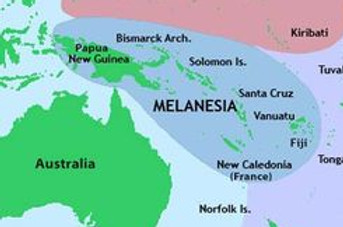
Melanesian culture, the convictions, and practices of the indigenous people groups of the ethnographic gathering of Pacific Islands known as Melanesia. From northwest to southeast, the islands structure a bend that starts with New Guinea (the western portion of which is called Papua and is a piece of Indonesia, and the eastern portion of which involves the free nation of Papua New Guinea) and proceeds through the Solomon Islands, Vanuatu (some time ago New Hebrides), New Caledonia, Fiji, and various littler islands. The Andesite Line, a land highlight of extraordinary volcanic and seismic tremor action, isolates Melanesia from Polynesia in the east and from Micronesia in the north, along the Equator; in the south, Melanesia is limited by the Tropic of Capricorn and Australia. Melanesia's name was gotten from the Greek means 'dark' and nesoi 'islands' as a result of the brown complexion of its occupants. In the mid-21st century, the number of inhabitants in Melanesia was roughly 10 million.
In spite of the fact that the ancient times of the majority of island Melanesia has not been completely reported, proof recommends that the social, semantic, and political discontinuity that won at the hour of European appearance, with about six dialects and societies frequently spoke to on a solitary island, was incompletely a result of the change that had happened during the past 2,000 years. Various leveled political frameworks and related exchange systems appear to have separated during this period and seem to have been joined by the expanding partition of language or vernacular gatherings. The reasons for these changes, maybe including internecine fighting and the spread of ailments (jungle fever specifically), stay hazy. These progressions were quickened by European appearance, which further upset exchange frameworks, escalated intercommunity fighting by providing guns, diminished populaces by presenting illnesses and contracted work, and dissolved conventional power frameworks. Europeans previously applied pilgrim impact in Melanesia in 1660, when the Dutch declared sway over New Guinea with an end goal to shield different nations from infringing on the eastern finish of the productive Dutch East Indies (presently Indonesia). Throughout the following, a few centuries Britain, the Netherlands, Australia, Germany, and Japan each settled provincial cases to different pieces of Melanesia. Frontier interruptions proceeded all through the twentieth century and into the 21st.
The pioneer forms that made the indigenous people groups of Melanesia become some portion of the world monetary framework incorporated the weights of Christianization and Westernization. In certain zones, these powers have worked for over a century. In different zones, in any case, especially the inside good countries of New Guinea, Western infiltration came as late as the 1930s or, in certain spots, the 1950s. By the mid-21st century, even the most far off locales had gotten available, and they have been changed. Vagrant settlements on urban peripheries proliferate, and relocation into towns is progressively normal, with the two marvels serving to connect the town and urban life.
Christianity has been a ground-breaking power of progress inside the area since the last part of the 1800s. In the pilgrim time frame, missions presented Western instruction and caused nearby financial change. Thus, a considerable lot of the pioneers in Melanesia have originated from mission schools and foundations, and some have been prepared as Christian priests or evangelists. During the late twentieth and mid-21st hundreds of years, the Melanesian postcolonial states were among the most Christian countries on earth.
Distinctive Christian sections, and even individual teachers, have in fluctuating degrees been thoughtful too and learned about nearby dialects and societies. Together, teacher work and the burden of pilgrim rule dispensed with an assortment of social conventions, some of which were very mind-boggling and rich, and others of which were vicious and exploitative.
Since the 1970s, global and transnational organizations have moved into Melanesia and have brought extra changes, particularly in Papua New Guinea. A large portion of the global logging interest in Melanesia has focused on that nation (which has in excess of 175,000 square miles [450,000 square km] of forested land). Logging likewise assumes a predominant job in the Solomon Islands, where it represents an enormous extent of product trades.
Mining—essentially by global organizations—has additionally gotten critical for some Melanesian nations, remarkably Papua New Guinea. Neighborhood restriction to copper mining on the island of Bougainville (some portion of Papua New Guinea) was clear when prospecting started during the 1960s. Albeit different specially appointed understandings were made, nearby landowners stayed disappointed with sovereignty and pay installments. In 1989 resistance and physical savagery concluded that mine. Another mine on Bougainville started creation in 1982 and furthermore ran into significant questions with landowners and common governments.
These types of financial improvement have caused the once in the past ridiculous Melanesian social orders to become class-delineated, with government officials, local officials, and businesspeople comprising a developing world-class. In addition, in any event in the English-talking regions, the elites progressively share a typical (Westernized and consumerist) culture and regular political and financial interests that cut across social, etymological and national limits.
Among the new world-class, social patriot philosophies have would in general spotlight on customary traditions (kastom) and "the Melanesian way." Cultural revivalism has become an unmistakable subject. Workmanship celebrations, social focuses, and belief systems of kastom have projected in a more positive light the customary social components, for example, stately trade, move and music, and oral conventions, that had for quite some time been smothered by the more traditionalist and evangelistic types of Christianity. The accentuation on conventional culture as a wellspring of character discovers articulation in the propagation or restoration of old frameworks of trade. In Papua New Guinea, the kula trade of shell armbands and pieces of jewelry proceeds in the Massim locale (in south-eastern Papua New Guinea), carried on via air travel and among legislators, experts, and community workers, just as by townspeople in kayaks. Individuals from the new tip top still prominently pay the bridewealth in shell resources.
Previously, Melanesia was a gathering ground of two social customs and populaces: Papuans and Austronesians. The soonest, or Papuan, custom is old. Papuans involved the Sahul mainland (presently incompletely lowered) at any rate 40,000 years back. As chasing and assembling people groups whose lifestyles were adjusted to the tropical rainforest, they involved the central zone of the mainland, which turned into the tremendous island of New Guinea after ocean levels rose toward the finish of the Pleistocene.
Current relatives of these early populaces communicate in dialects that have a place with various families that together are sorted as Papuan dialects. Papuan people groups tamed root yields and sugarcane and may have kept household pigs as ahead of schedule as 9,000 years back, contemporaneous with the beginning of horticulture in the Middle East. By 5,000 years back agrarian creation in parts of the New Guinea good countries had fused frameworks of water control and pig farming, the two of which were escalated over resulting centuries.
Around 4,000 years prior, Austronesian people groups moved into the region, showing up via ocean from Southeast Asia. By 3,500 years prior they had involved pieces of the islands of the Bismarck Archipelago. Their quality is set apart by the presence of the particular ceramics, devices, and shell adornments that characterize the Lapita culture. They communicated in an Austronesian language identified with dialects of the Philippines and Indonesia and tribal to a large number of the dialects of beachfront eastern New Guinea; a significant part of the Bismarck Archipelago; the Solomon’s, Vanuatu, and New Caledonia; and those of focal and eastern Micronesia and Polynesia.
Proof of significant distance exchange, especially of shell adornments and obsidian, recommends that the general spread networks portrayed by the Lapita convention had become connected politically by 3,000–3,500 years prior. The settlement of eastern Micronesia by Austronesian speakers, maybe from the Solomon’s, clearly occurred during this period. Fiji was first colonized by Lapita people groups and turned into a springboard to the settlement of western Polynesia. The Austronesian speakers, who had an oceanic direction and refined seagoing innovation, most likely had an arrangement of innate bosses with political-strict position. They likewise had expanded cosmologies and complex strict frameworks that were like those recorded in western Polynesia.
The Bismarck Archipelago east of New Guinea was at that point involved by speakers of Papuan dialects when the Austronesians showed up. The populaces that currently involve the archipelago and the circular segments of islands reaching out toward the southeast speak to the blending of Papuan and Austronesian people groups and societies. The blending may have occurred to a great extent inside the Bismarcks before the islands toward the southeast were settled, despite the fact that the specific procedures included, and the overall commitments of these chronicled populaces are discussed. A lot of financial trade occurred between the Austronesian people groups, whose economies depended on root-and tree-crop development and on oceanic innovation, and the Papuans, who likewise had very much evolved horticultural and mechanical frameworks. It is likely that an exchange of other social customs, from social association to religion, occurred also. In any case, some Austronesian-talking networks—maybe those that held their sea direction—seem to have remained moderately segregated from intermarriage and social trade.
In spite of the fact that the blend of Austronesian and Papuan social components changes across Melanesia, from multiple points of view the joint order of both Austronesian people groups and Papuan people groups as Melanesians—rather than Micronesians and Polynesians—does damage to the ethnological, etymological, and archaeological proof. The Austronesians of northern Vanuatu and the south-eastern Solomon’s communicate in dialects firmly identified with those of Polynesia and eastern Micronesia. Socially, Austronesians are from multiple points of view all the more firmly identified with these other Austronesian-talking people groups than to the Papuans of inside New Guinea. Their strict frameworks are likewise like those in Polynesia and, for instance, fuse such ideas as mana ("intensity") and, in the Solomon’s, tapu ("sacrosanct"; see no-no).
In numerous regions of Melanesia, nearby gatherings lived in dissipated estates and villas as opposed to towns. Regularly these settlements were involved for brief periods until the gatherings proceeded onward to follow development cycles. As a rule, bigger, more perpetual settlements were normal for beachfront conditions, and littler, moving ones were normal for inside territories. Where people group were at risk for shock assault, they would in general bunch all the more intently. In inside zones, they were normally sited on edges and pinnacles.
In parts of the Sepik River zone of Papua New Guinea, enormous towns—some with populaces of in excess of 1,000 individuals—spoke to the conglomeration of plummet based nearby gatherings. In the Trobriand Islands (in the Massim territory of south-eastern Papua New Guinea), towns of up to 200 individuals were displayed around a focal move ground. Towns in any event as enormous were pressed together on coral stages in the tidal ponds of northern Malaita, in the Solomon Islands.
Private division of people was normal. Ladies and youngsters ordinarily involved household residences, while men lived in clubhouses or religious houses, a focal point of custom and military solidarity normal in numerous territories of Melanesia. The enormous religious places of the Sepik River bowl and the southern Papuan coast are models. In the rocky inside of New Guinea, men's longhouses were worked as guards against the danger of attacking and as focuses of faction exercises.
In certain pieces of Melanesia, male-female connections were captivated. In New Guinea, a zone of outrageous polarization reached out from the Papuan coast (Marind-anim and Asmat people groups) along the southern substance of the Highlands (Anga speakers and Papuan level people groups) and the high focal mountains (Mountain Ok people groups) down into the Sepik. People groups all through this zone were distracted with thoughts regarding development and the physical liquids and substances (semen, vaginal liquids, and menstrual blood) that they viewed as specialists of propagation and development. These were viewed as intrinsically incredible and in this way conceivably perilous.
Sex restriction was the reason for this current region's division of work: as the significant food makers for their networks, ladies guaranteed the gathering's physical endurance; men guaranteed the gathering's magical endurance by taking part in exercises intended to control the indescribable, as spoke to by body liquids and other "solid" substances. These exercises stressed enrolment in mystery single-sex religions in which they rehearsed ritualized homosexuality, watched expand inception customs, and praised fighting.
Concerns identified with regenerative liquids repeated all through Melanesia in different structures, in spite of the fact that relations between the genders were frequently observed as corresponding instead of clashing. The focal job of ladies in regular residential governmental issues was generally esteemed and perceived, and in numerous regions custom status or nearby gathering, alliance depended on maternal just as fatherly connections. Moreover, ladies were frequently agreed to significance in custom and as healers, older folks, and progenitors. In the eastern Highlands, gendered social customs included old stories identifying with an old female force who fell under the control of men, the physical partition of the genders, and men's introductions, clique ceremonies, utilization of sacrosanct woodwinds, and ritualized nose-or penis-draining services (apparently in impersonation of monthly cycle). In the Sepik bowl, edifices of "pseudo procreative" custom went with male clique exercises.
In the focal and western Highlands, where populaces were thick and yam and pig creation were concentrated, men's carries on with concentrated on the legislative issues of removing female work, obtaining eminence and force through trade, and assembling outfitted quality, all of which subjected their alleged danger of contamination by the female body.
In the Massim region, the regenerative and profitable forces of ladies were spoken to in social relations and in belief systems of drop and inestimable procedures, and in certain zones, ladies played noticeable parts in specific customs. Matrilineages (in a significant part of the Massim called susu ["breast" or "bosom milk"]) gave images of astronomical generation just as physical and social multiplication. While some polarization of the genders is accounted for in accounts from the Solomon’s and Vanuatu, there the sexual isolation of and worries with custom contamination appear to have had more to do with the safeguarding of emblematic limits than with inalienable risks credited to real characters.
The social orders of precolonial Melanesia naturally sorted out themselves into nearby gatherings that depended on family relationships and drop and connected together by intermarriage. In the typical nonappearance of concentrated political foundations, these nearby gatherings were generally self-ruling. In many territories they were generally little, having somewhere in the range of 20 and 100 individuals. In thickly settled territories of the New Guinea Highlands and parts of the Sepik River region, notwithstanding, connection and plunge based nations were impressively bigger.
Under this framework, residential gatherings or people regularly held rights over nurseries and developed trees, while nearby family bunches held corporate title to the land itself. That is, land was acquired and held aggregately by the relatives of the individuals who at first cleared it. Use rights may then be stretched out to other people. In beachfront zones, corporate title may likewise get for reefs or fishing grounds. In numerous territories, the connection among individuals and land was conceptualized as far as chains of the plunge from a gathering of establishing predecessors, the connections of which could be figured through the male line (patrilineal plummet), the female line (matrilineal drop), or some blend thereof (cognatic plummet). Patrilineal plummet frameworks win in a large portion of swamp New Guinea, northern Vanuatu, and New Caledonia, and matrilineal plunge frameworks are utilized in a significant part of the Massim, the Bismarck Archipelago, and the Solomon Islands. All things considered; extensive variety is found inside these regions.
Social orders of the focal and western Highlands of New Guinea have been portrayed as segmentary patrilineal drop frameworks. The segmentary structures, or phratries—basically gatherings of groups that share a legendary predecessor—naturally use sibling and father-child connects to speak to what were once in truth generally unsteady political partnerships. Phratries were significant when intergroup fighting was basic since they gave a structure through which to conjoin in any case indirectly related gatherings during a period when the sheer size of neighborhood countries was a key to endurance. While a few gatherings have kept on underlining the chains of plummet interfacing the living to their predecessors, most appear to be indifferent with such associations. They use father-child joins as the primary instrument of gathering enrolment yet are available to the connection of outcasts and people associated with ladies.
Ties of intermarriage were significant in making and keeping up associations between drop or family relationship-based neighborhood gatherings. Relationships haggled with adversaries made at any rate transitory partners of them. Where marriage involved an exchange of rights to a lady's youngsters and work from her natal family to that of her better half, it was approved by the bridewealth as pigs or different resources or administrations. This custom, wherein a lucky man's family remunerates a lady of the hour's family for the loss of her work and as a guarantee of reasonable treatment for the lady of the hour and any offspring of the marriage, has stayed versatile in quite a bit of Melanesia in spite of Christianity and industrialist monetary connections.
Polygyny, a type of marriage wherein at least two spouses share a husband, was generally far-reaching, in any event for noticeable pioneers. It likewise would in general sustain the social progressive systems inside a network, as polygynous families had more profitable and regenerative work with which to amass surplus pigs and root crops than did those of their monogamous partners. In certain regions, as in the Trobriand Islands, polygynous relationships of high-positioning pioneers were instruments of political partnership and of feeder connections between drop based nearby gatherings. For instance, in the Trobriands, in light of the fact that a matrilineal subclan was committed to developing sweet potatoes and formally present them to the spouses of its missing female individuals, a pioneer with numerous wives turned into a focal point of sweet potato conveyance. Where polygyny was not rehearsed, pioneers could draw work from their supporters by financing the bridewealth installments of auxiliary families.
Family relationship ties made through marriage partnerships crosscut and were corresponding to divisions dependent on unilineal plunge. In the patrilineally composed social orders of marsh New Guinea and island
Melanesia, an individual's association with the mother's gathering and progenitors was frequently perceived in demonstrations of family relationship support, in custom, and in the parts played by the gatherings in relationships, funeral home functions, and different trades. In the matrilineally composed social orders of island Melanesia, binds to the dad's family members were comparatively communicated. The integral parts played by maternal and fatherly subclans in Trobriand funeral home ceremonies were especially mind-boggling. All through Melanesia, commitments toward kinfolk established a definitive good objective. Frameworks of trade became out of family relationship commitment. Rights getting from birth regularly must be approved by endowments or the satisfaction of commitments.